
 MORE LOCATIONS
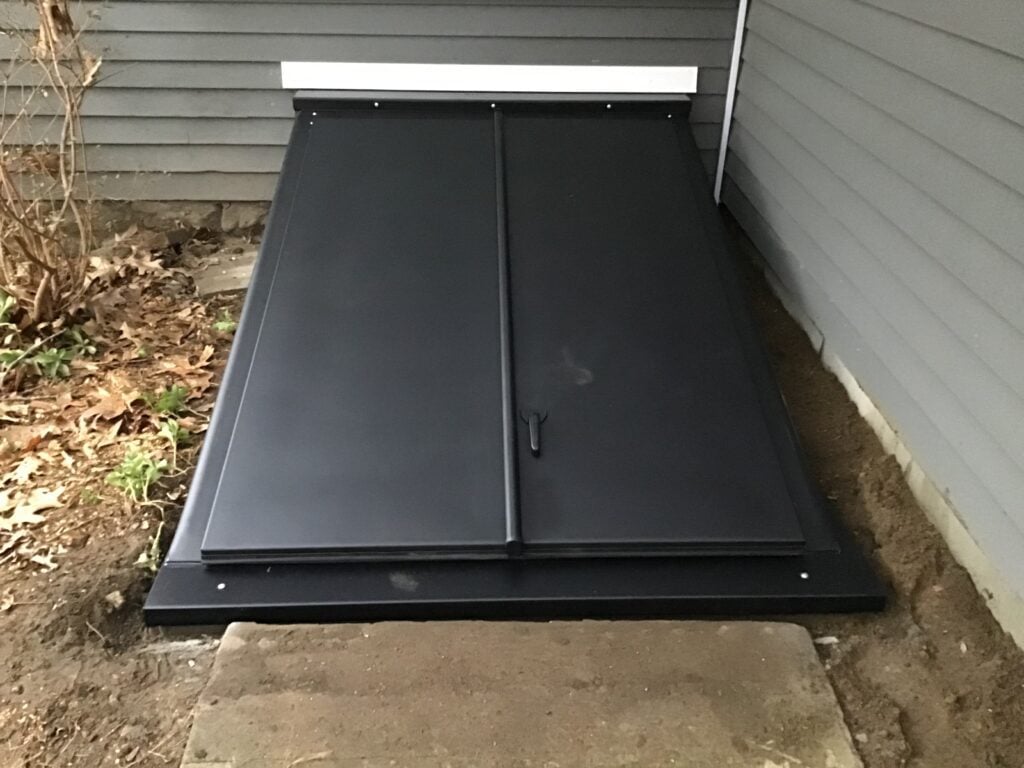
For many homeowners across Massachusetts, New Hampshire, and the greater New England region, the basement bulkhead door—often called a hatchway or Bilco door—is an essential feature for moving large items, furniture, and seasonal gear in and out of the lower level. However, if you step down your basement stairs after a heavy rain and notice puddles pooling around the bottom threshold, you are likely dealing with one of the most stubborn water intrusion points in residential construction: bulkhead seam leaks.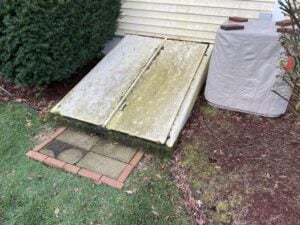
The Vulnerability of New England Bulkhead and Hatchway Entrances
Bulkhead entrances endure punishing treatment from the elements throughout the year. They sit flat or at a slanted angle, exposed directly to pouring rain, melting snowbanks, and freezing temperatures.
The Steel-to-Concrete Connection
A typical bulkhead consists of a prefabricated steel door frame bolted and mortared directly against a poured concrete or concrete block stairwell opening. This creates a critical intersection where two entirely different building materials meet: structural concrete and heavy gauge steel.
The Cold Joint Issue: Differential Movement
Concrete and steel expand and contract at different rates under thermal changes. Furthermore, the concrete stairway structure often settles at a slightly different rate than the main home foundation wall. This differential movement creates a microscopic gap or “cold joint” right along the threshold where the bulkhead frame meets the concrete. When New England groundwater rises or surface water pools against the stairwell, it pours directly through this gap.
Why External Caulking and Tar Patches Continuously Fail
When homeowners notice water weeping around their bulkhead frame, their first instinct is usually to grab a tube of exterior silicone caulk, hydraulic cement, or black asphalt roofing tar and smear it heavily along the outside corners.
Freeze-Thaw Shifting Pops Surface Sealants
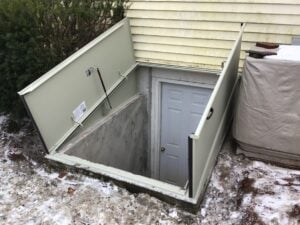
External surface patches fail rapidly because they sit entirely exposed to the elements. During New England winters, freeze-thaw cycles cause the concrete and steel to shift, instantly cracking brittle exterior caulking or asphalt patches. Within 12 months, water finds its way right back through.
The Trapped Moisture Trap
Applying impermeable tar or caulk on the outside of a bulkhead seam often acts as a trap. Water migrating from the surrounding soil gets trapped behind the patch, accelerating the breakdown of the underlying concrete and mortar through freeze-thaw expansion and efflorescence.
The Polyurethane Injection Fix for Hatchway Seams
Permanent waterproofing requires addressing the leak from the inside out, filling the entire depth of the concrete-to-steel cold joint rather than just skinning the surface.
Low-Pressure Injection Into the Seam
Professional bulkhead waterproofing relies on low-pressure polyurethane injection. Technicians install injection ports directly along the leaking wall and floor seams of the bulkhead stairwell. Hydro-active polyurethane resin is pumped into the joints under controlled pressure.
Expanding Elastomeric Gaskets
The liquid polyurethane travels deep into every micro-fissure and void behind the bulkhead frame. Upon contacting moisture, the resin expands up to 30 times its liquid volume, forming a dense, flexible elastomeric gasket. Because polyurethane remains permanently flexible, it expands and contracts naturally alongside the steel and concrete during temperature fluctuations, sealing out water for good.
Frequently Asked Questions
Q: Why does water pool at the bottom of my basement bulkhead stairs?
A: Water typically penetrates the cold joint seam where the prefabricated steel bulkhead frame meets the poured concrete foundation stairwell. Gravity pulls this seepage down the stair treads and onto your basement floor slab.
Q: Do I need to replace my entire steel bulkhead door if it leaks at the concrete wall?
A: Rarely. Most bulkhead leaks stem from failing concrete-to-metal transition seams and deteriorated mortar joints, which can be professionally injected and permanently sealed from the inside at a fraction of full replacement costs.
Q: How long does a bulkhead injection repair take to complete?
A: Professional technicians can prep, port, inject, and seal a leaking hatchway or bulkhead seam in just a few hours, leaving your stairwell clean and watertight with zero yard excavation.