
 MORE LOCATIONS
The Geology Behind New England Basement Leaks
Thousands of years ago, retreating glaciers scraped across New England, leaving behind an unsorted, highly compacted mixture of clay, silt, sand, gravel, and boulders known as glacial till. Unlike sandy coastal soils that allow rainwater to drain rapidly downward, glacial till and dense clay act almost like a dense sponge with extremely low permeability.
Dense Clay & Soil Saturation in MA, NH, and ME
When heavy rains hit, or snowpacks melt rapidly, the dense clay layers surrounding your home’s foundation cannot absorb or disperse the water quickly. Instead, the excavated pit originally dug to build your foundation—known as the “backfill zone”—becomes a subterranean reservoir. Because backfill soil is looser than the undisturbed surrounding glacial till, groundwater flows directly into this perimeter trench, trapping thousands of gallons of water directly against your concrete walls.
What Happens During Heavy Nor’easters and Spring Thaws
During New England nor’easters or the early spring thawing period, the soil surrounding your home reaches 100% water saturation. With nowhere else to go, this trapped water exerts immense physical force against subterranean concrete structures.
Understanding Hydrostatic Pressure on Poured Concrete Walls
Hydrostatic pressure is the continuous physical force exerted by standing water due to the force of gravity. Water weighs approximately 62.4 pounds per cubic foot. When subterranean soil becomes completely waterlogged, hundreds of pounds of lateral hydraulic pressure push against every square foot of your basement wall.
Forces Pushing Water Through Micro-Fissures
Concrete is inherently a porous material. Under normal conditions, minor ground moisture stays outside. However, under extreme hydrostatic pressure, water actively forces its way through microscopic pores, cold joints, tie rod holes, and shrinkage cracks in poured concrete walls. What starts as a damp spot on the wall eventually becomes a steady trickle across your basement floor.
The Cove Joint Vulnerability
Hydrostatic pressure does not just push horizontally against foundation walls; it also pushes vertically upward from beneath your basement floor slab. This upward force often drives groundwater through the cove joint—the small seam where your basement floor slab meets the footing and vertical wall. If you notice water trickling in along the perimeter floor edge without an obvious wall crack above it, rising hydrostatic pressure is the primary driver.
Why External Excavation Isn’t Always Necessary
For decades, traditional contractors insisted that fixing hydrostatic basement leaks required digging a trench around the outside of your home down to the footings—a costly process that destroys landscaping, decks, and walkways, often costing upwards of $15,000 to $20,000.
Low-Pressure Interior Injection Technology
Modern structural engineering provides a far superior, non-invasive alternative: low-pressure chemical injection performed entirely from the inside of your basement.
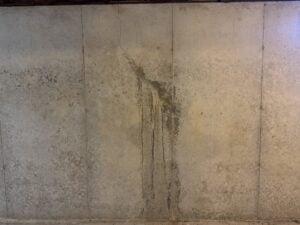 By injecting commercial-grade polyurethane or structural epoxy resins directly through ports installed along wall cracks, technicians can seal the entire depth of the wall cavity. Hydro-active polyurethane resins react with the moisture inside the crack, expanding up to 20 to 30 times their liquid volume. This forces the sealant clear out to the exterior soil line, creating a flexible, permanent elastomeric gasket that completely blocks hydrostatic water intrusion at the outer wall face—without disturbing a single blade of grass in your yard.
Frequently Asked Questions
Q: Why does my New England basement only leak during heavy rain or snowmelts?
A: New England’s dense glacial till soil retains water rather than draining quickly. As the water table rises during storms or rapid snowmelts, it creates intense hydrostatic pressure that forces groundwater through microscopic concrete pores, tie rod holes, and hairline cracks.
Q: Can hydrostatic pressure push water through solid concrete?
A: Yes. Poured concrete is porous. Under continuous hydraulic pressure, groundwater easily migrates through micro-fissures, construction joints, and tie rod penetrations left over from original formwork.
Q: Does sealing a basement wall crack stop hydrostatic pressure?
A: High-expansion polyurethane injection fills the entire crack void from the inside out to the exterior soil line. This seals the entry pathway completely, preventing water from ever penetrating the wall cavity while withstanding external groundwater pressure.