 MORE LOCATIONS
Discovering a crack running down your basement wall is concerning, but noticing that the wall itself is beginning to curve, bulge, or tilt inward is a major red flag. In New England, severe hydrostatic soil pressure, freezing winters, and clay-rich soil exert enormous lateral force against subterranean concrete structures.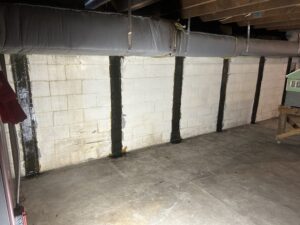
Assessing the Problem: Water Seepage vs. Structural Inward Bowing
Before choosing a repair strategy, a professional technician must determine whether your foundation is experiencing simple material shrinkage or active structural deflection under soil pressure.
Water Seepage in Flat Walls
When concrete cures, minor shrinkage cracks form. Over time, groundwater forces its way through these fissures. If the wall remains perfectly plumb and vertical—with no inward deflection or offset—the core issue is water intrusion rather than structural instability.
Structural Inward Bowing
If heavy subterranean soil pushes the center of a basement wall inward—creating a horizontal fracture across the midsection or stair-step cracking near corners—the wall’s structural integrity is compromised. Once a foundation wall bows inward by even a fraction of an inch, its load-bearing capacity decreases significantly, requiring immediate mechanical stabilization.
Low-Pressure Crack Injection: Stopping Water Intrusion
Low-pressure chemical injection is the industry gold standard for restoring cracked concrete walls that have not lost their structural alignment.
How Crack Injection Works
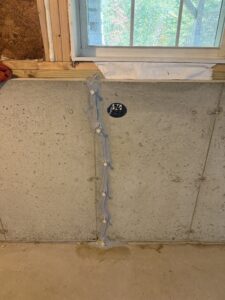
Technicians install injection ports along the line of the crack and seal the outer face with an epoxy surface paste. High-grade liquid polyurethane or structural epoxy resin is then injected directly into the ports at low pressure. The resin travels completely through the wall cavity out to the exterior soil line.
Strengths & Limitations
- Polyurethane Resins: React with ambient moisture to expand up to 30 times their liquid volume, forming a permanent, flexible gasket that withstands freeze-thaw shifts and active leaks.
- Structural Epoxies: Cure into a rigid matrix with tensile strengths exceeding the original concrete, bonding split concrete back together.
- Limitation: While epoxy bonds cracked concrete, neither epoxy nor polyurethane can pull a bowed wall back into place or prevent a severely deflection-compromised wall from continuing to bow under external soil pressure.
Carbon Fiber Reinforcement: Locking Bowed Walls in Place
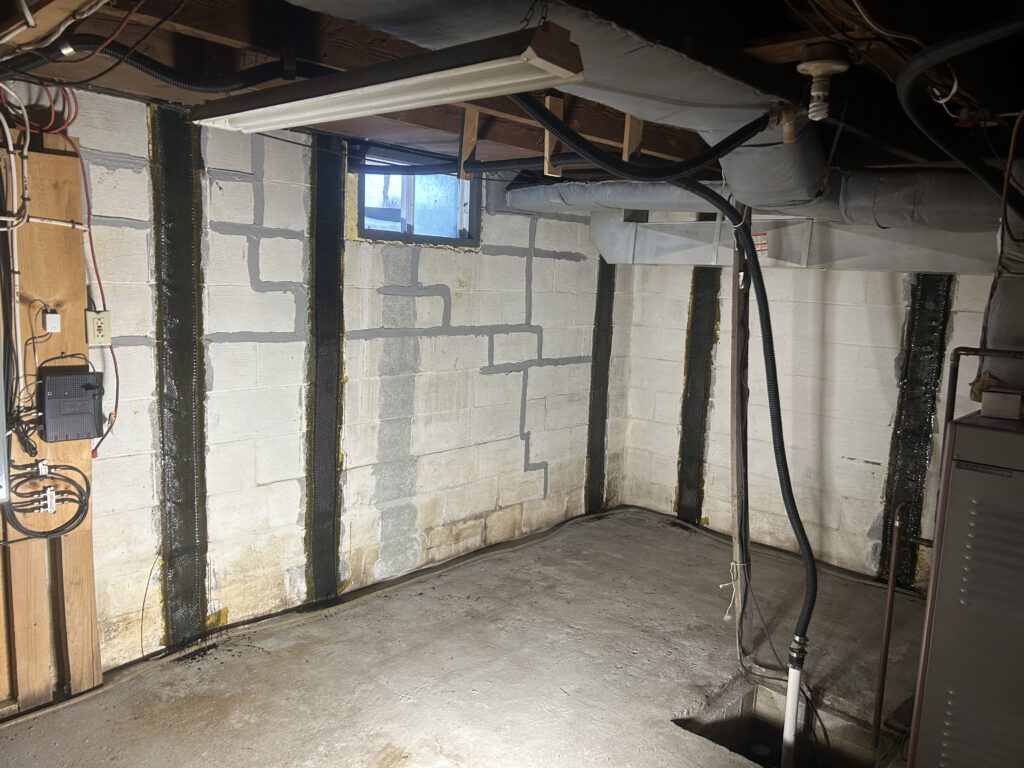
When soil pressure causes a foundation wall to deflect inward, carbon fiber strapping provides an advanced, non-invasive structural reinforcement solution that avoids total wall replacement or messy exterior excavation.
How Carbon Fiber Strapping Works
Aerospace-grade carbon fiber grid straps are bonded vertically to the interior surface of the basement wall using high-strength structural epoxy adhesives. The straps are anchored to the top sill plate and floor footing to redistribute lateral soil load across the entire wall height.
Strengths & Advantages
- Unmatched Tensile Strength: Carbon fiber is ten times stronger than structural steel, preventing any further inward movement or deflection.
- Zero Space Intrusion: Straps adhere flush against the concrete surface, measuring less than a fraction of an inch thick. They can be smoothly painted over or framed directly behind finished basement drywall.
- Maintenance-Free: Carbon fiber will never rust, stretch, or deteriorate over time.
Hybrid Solutions: When Your Foundation Requires Both Methods
For many New England homeowners, foundation damage isn’t strictly an “either/or” situation. Heavy hydrostatic pressure often creates an active water leak along the exact horizontal or vertical fracture caused by structural bowing.
The Two-Step System Repair
In these cases, a complete repair involves a hybrid approach:
- Step 1 (Sealing): Technicians inject expanding polyurethane or high-tensile epoxy into the crack void to stop groundwater infiltration completely and fill internal air cavities.
- Step 2 (Stabilization): Carbon fiber straps are installed directly over and across the repaired wall section, locking the concrete structure in place and countering lateral soil forces indefinitely.
Frequently Asked Questions
Q: How do I know if my basement wall is bowing or just cracked?
A: Run a level vertically down the wall or stretch a mason’s string line corner-to-corner across the inner wall face. Any visible middle bulge, inward tilt at the top, or deflection exceeding 0.5 inches indicates active structural bowing that requires stabilization.
Q: Can carbon fiber straps replace full foundation wall rebuilds?
A: Yes. If inward wall deflection is caught early (typically under 2 inches of bow), carbon fiber straps permanently stabilize the wall without requiring full foundation replacement or costly exterior excavation.
Q: Does carbon fiber wall repair take up usable floor space in finished basements?
A: No. Carbon fiber straps lie virtually flat against the concrete surface and can be painted over or easily concealed behind standard wood framing and sheetrock.